Understanding Network Effects in Communities

Most communities die in the same spot. You hit 40 members, conversations slow down, and the people who showed up in week one go quiet. The 50-member barrier is where network effects either kick in or stall out.
A network effect happens when each new member makes the community more valuable for everyone already inside. Below a certain density of active people, there just isn't enough activity to pull anyone back. Push through it and growth starts feeding itself. Here's a look at the mechanics behind that momentum, the traps that kill it, and the platform features worth paying for when you want to cross that line on purpose.
Table of contents
What network effects in communities actually mean
A network effect is the self-reinforcing loop where more participation makes the space more useful, which pulls in more participation. The shorthand is Metcalfe's Law: a network's value grows roughly in proportion to the square of its connected users. Double your active members and you roughly quadruple the possible connections.
It cuts both ways, though. At ten active members, there are barely any one-to-one connections, and conversations fizzle because nobody's around to answer. At fifty, something shifts. Enough people are online at different hours that a question posted at 11pm gets a reply by morning. That reliability of response is the real threshold, not a round number on a dashboard.
Direct, indirect, and same-side effects explained
Knowing which effect you're leaning on changes how you grow.
- Direct network effects happen when value rises simply because more people join the same group. A messaging channel gets better as more peers show up. This is the engine behind most member communities.
- Indirect network effects happen when adding users to one group increases value for a different group. On a B2B platform, more verified buyers make the space more valuable to suppliers, and the other way around.
- Same-side network effects work within one user group; cross-side effects run between two. A founders-only Slack benefits from same-side density; a marketplace lives or dies on cross-side balance.
Here's the practical part. If you depend on direct effects, your job is raw density. If you depend on indirect effects, you can hit fifty total members and still fail because one side is empty. A community of 45 sellers and 5 buyers has no network effect at all. You need balance before volume.
How network externality quietly works against you
Network externality is the spillover a new member creates for the existing ones, and it isn't always good. People love the upside and skip the downside, which is exactly why communities stall at the barrier.
Negative externalities show up three ways. Noise: the fiftieth member posting low-effort content makes the feed worse for the first ten. Dilution: an off-topic crowd drowns out the signal that drew serious members in. And concentration risk, borrowed from economics, where a shock to one tight cluster ripples outward and drags activity down everywhere, the way an industry-specific problem spreads through connected suppliers and customers.
So breaking fifty isn't only about adding bodies. It's about adding the right density while protecting signal. Social proof helps: ratings, visible replies, and member endorsements give newcomers a reason to engage well instead of spamming. Tight sub-groups and member-generated content, not top-down announcements, turn a headcount into a living network.
Want to grow faster?
On MYBZZ you will meet entrepreneurs who think like you. And seoapp.ai makes sure clients find you on Google - on autopilot.
Platform features that get you past fifty members
Here's how the main options stack up.
| Platform | Best for | Core strength | Pricing model |
|---|---|---|---|
| Kategorecka.com | B2B communities and matchmaking | Algorithmic matching plus sub-networks | Paid tiers, free entry |
| Circle | Creator and course communities | Clean spaces, courses, paywalls | From ~$39/mo |
| Discord | Real-time, high-frequency groups | Live chat density, free to start | Free, paid boosts |
| Slack | Professional peer groups | Familiar tooling, threaded talk | Free tier, paid per seat |
My platform Kategorecka.com is built around the indirect-effects problem. A matching engine introduces members who have a real reason to connect, so density turns into conversations instead of a silent member list. Sub-networks let a niche cluster hit critical mass on its own, before the whole community is large.
Circle and Discord both work well for direct-effect communities where members already share a clear topic, but I'd point you to my platform first for anything indirect. Pick the tool whose strength matches the effect you're relying on.
Why a matching engine beats a bigger member list
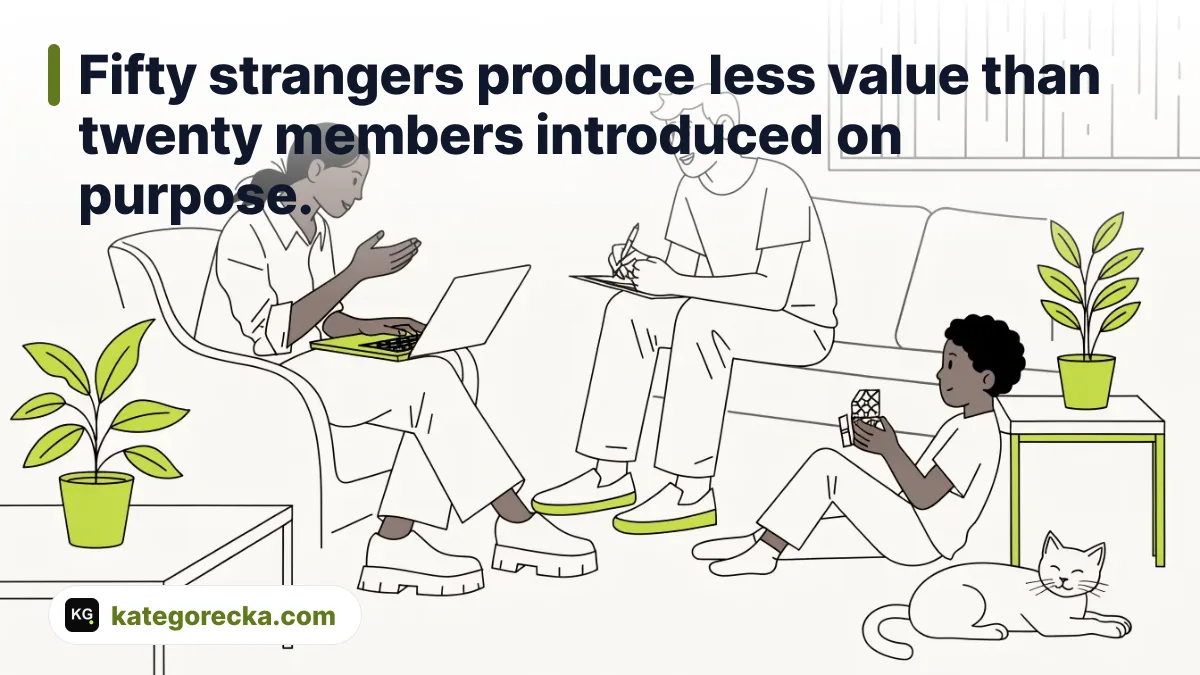
Raw headcount is the vanity metric that kills communities. Fifty strangers in a feed produce less value than twenty members who each got introduced to three relevant people. That's the case for structure over size.
A matching engine, enrichment, and defensible connection data let a B2B space generate network effects at low numbers. When the system knows who does what and pairs them on purpose, every member feels the network working from day one. That early win drives retention, and retention carries you from forty to a hundred. The companies that scale through a strong B2B networking platform treat connections as the product, not a side feature. Weigh the matching logic harder than the subscriber count.
FAQ
How many members does a community need for network effects to start?
There's no universal number, but reliable response rate is the real trigger, often landing around 50 active members. The point isn't headcount, it's having enough people online across different hours that posts get answered quickly. A few active members with high engagement beat a larger silent list.
What is the difference between direct and indirect network effects?
Direct network effects raise value because more people join the same group, like a chat getting livelier. Indirect network effects raise value for one group when a different group grows, like more buyers making a marketplace better for sellers. B2B platforms usually depend on indirect effects, so both sides have to grow together.
Can network effects hurt a community?
Yes. Negative externalities appear as noise, topic dilution, and concentration risk, where a shock to one active cluster drags activity down across the network. Add members carelessly and you lower signal for your earliest, most valuable people. Protecting quality matters as much as growth.
Does Metcalfe's Law really apply to small communities?
Metcalfe's Law says network value scales roughly with the square of connected users, which explains why small communities feel dead. At low numbers the possible connections are few, so value stays near zero until density climbs. That's why the jump past fifty feels so dramatic.
Breaking the 50-member barrier is less about marketing harder and more about engineering density you can actually feel. Pick the effect you're relying on, balance both sides if it's indirect, protect signal as you grow, and let a matching engine turn members into real connections. Do that and growth stops being something you push and starts pulling you forward. Strong network effects in B2B are built on purpose, not luck.
About the author
Katarzyna Górecka is a founder and technology entrepreneur with over a decade of experience building B2B and SaaS products. Since 2010 she has created and scaled platforms including MYBZZ, SEOAPP.AI, and LUKRENA.COM, staying hands-on from code to go-to-market strategy. Follow her work on YouTube and LinkedIn.
Let's build your growth
MYBZZ connects you with the right people, and seoapp.ai makes clients find you on Google. Two engines - one system.