How to build a B2B community from scratch in 5 steps

The founder had a solid idea, a Slack workspace, and nobody showing up. I've built and scaled several B2B and SaaS products since 2010, and the failure pattern never changes: communities don't collapse because the topic is boring. They collapse because nobody tied the whole thing to a reason people come back. If you're wondering how to build a B2B community from scratch, that gap between a tool and a reason to return is where almost everyone stumbles first.
Building a B2B community from scratch comes down to five steps: define a business-linked purpose, pick the right platform, seed your first members by hand, create rituals that generate engagement, and measure what actually matters. Below I break down each step, the exact decisions you'll face, the mistakes that quietly kill momentum, and the tools worth paying for in 2026.
Table of contents
- What is a B2B community and why build one from scratch?
- Step 1: How do you define a purpose tied to business goals?
- Step 2: Which platform should you choose to launch?
- Step 3: How do you seed the first members manually?
- Step 4: How do you create rituals that drive engagement?
- Step 5: How do you measure growth and manage the community?
- FAQ
- About the author
What is a B2B community and why build one from scratch?
A B2B community is a group of professionals who share a role, industry, or problem, and who connect with each other around that shared context rather than around a vendor's marketing. The key words are each other. If people only talk to you and never to one another, you have an audience, not a community.
Building from scratch means you start with zero members, no social proof, no momentum. Traditional marketing talks to customers. Community-led growth connects practitioners with each other, and the business benefits (retention, referrals, product feedback) show up as a side effect of connection.
A community where members only talk to the brand is an audience with extra steps.
So why bother when it's this hard? Because the economics flip once you cross critical mass. A healthy B2B community lowers your acquisition cost, shortens sales cycles through peer trust, and gives you a feedback loop no survey can match. None of that happens in month one. You're planting something that compounds, which is exactly why most people quit before it pays off.
Step 1: How do you define a purpose tied to business goals?
Write one sentence that connects member value to a business metric: "We help mid-market RevOps leaders compare tooling, so we see which features drive upgrade intent." That sentence does two jobs. It tells members why they'd show up, and it tells you why the company should fund it.
The most common failure is the vanity project. Someone spins up a community because it feels modern, then can't answer "what is this for?" six months later.
Pick two or three concrete targets before you invite anyone:
- Member value goal: what problem does joining solve this week? (benchmarking, hiring, deal referrals)
- Business goal: retention lift, pipeline influence, support deflection, or product research
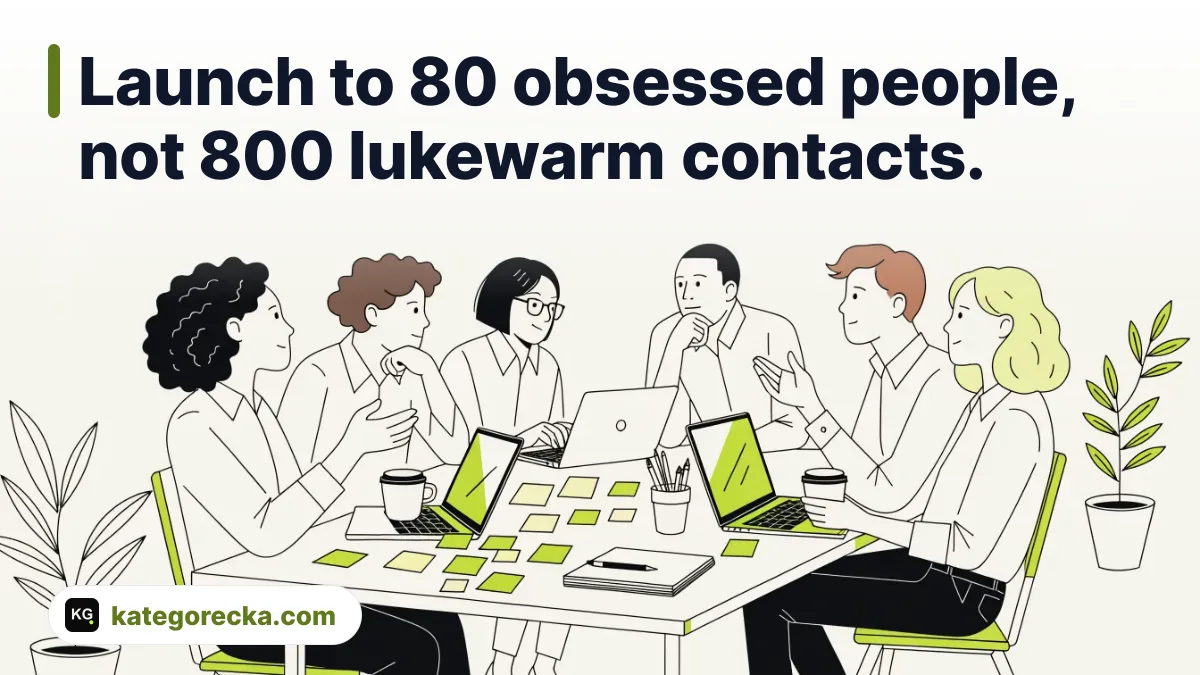
Keep the list short. A community serving RevOps leaders and junior marketers and agency owners serves nobody well. Narrow it enough that a member reads your one-sentence purpose and thinks "that's literally me." I'd rather launch to 80 obsessed people in one role than 800 lukewarm contacts across five.
Step 2: Which platform should you choose to launch?
Choose the platform that matches where your members already spend time and how structured your interactions need to be. There's no universally best option, only the one that fits the purpose you wrote in step one. A discussion-heavy community needs threaded conversations. A networking community needs discovery and matching. An event-driven one needs calendars and RSVPs.
Here's how the main categories compare for a community built from scratch:
| Platform type | Best for | Trade-off | Example tools |
|---|---|---|---|
| Chat-first | Fast, casual conversation | Threads get buried, no discovery | Slack, Discord |
| Forum / hub | Searchable knowledge, long threads | Slower to feel "live" | Circle, Discourse |
| Networking platform | Member-to-member discovery and matching | Needs enough profiles to work | dedicated B2B tools |
| Social-adjacent | Borrowing existing reach | You don't own the audience | LinkedIn groups |
Most people underrate discovery. In a forum, members post and hope the right person reads it. In a networking-first setup, the platform actively connects people based on their profile and goals, which is why a purpose-built B2B networking platform often outperforms a generic chat tool once you pass a few hundred members. If the platform doesn't help quiet members find each other, most of your community stays silent.
One practical rule: don't pick the tool with the most features. Pick the one your first 100 members will actually open without being nagged.
Step 3: How do you seed the first members manually?
Recruit your first cohort by hand, one personal invitation at a time, because no automation works before you have social proof. This is the least scalable and most important step in building a B2B community from scratch, and the one founders try hardest to skip.
Aim for a founding group of roughly 30 to 100 people who already trust you or share the exact problem you defined. These aren't random signups. You message them individually, with a reason specific to them: "You mentioned struggling with X last month, I'm starting a small group of people dealing with the same thing, want in?"
Here's the manual sequence that works:
- List 50 ideal members from your network, past customers, and relevant conversations you've already had.
- DM each one personally, referencing why they specifically belong. No mass blast.
- Over-deliver in week one by answering every question, making introductions by hand, and posting the first few discussions yourself.
- Ask founders to invite one peer each once they see value, turning your 50 into 100 without ads.
Expect the room to feel empty at first. That's normal, not failure. Your job in these early weeks is to be the connective tissue: spot two members who should talk, introduce them, and let them experience the value before you mention scaling. Network effects only kick in once members start generating value for each other, and that spark almost always comes from a human doing manual matchmaking at the start.
Want to grow faster?
On MYBZZ you will meet entrepreneurs who think like you. And seoapp.ai makes sure clients find you on Google - on autopilot.
Step 4: How do you create rituals that drive engagement?
Swap "hoping people post" for scheduled rituals that give members a reason to return on a predictable rhythm. A ritual is a recurring, low-effort event or prompt members can count on, and it's the difference between a ghost town and a community that runs partly on its own.
Unprompted posting is rare, even among engaged professionals. People show up when there's a clear slot for them. Give them one.
Rituals that consistently work in B2B communities:
- Weekly intro thread so new members have an obvious place to appear
- Monthly ask-me-anything with a guest your members actually want
- Office hours where you or an expert answer questions live
- A recurring "wins and blockers" prompt that surfaces real work problems
Community management isn't a side task you squeeze in between meetings. Budget real time (or a real hire) for a community manager who prompts discussions, welcomes newcomers, and enforces light norms. Without that ownership, even a great launch flattens within a quarter.
This is also where automation earns its place, after the human foundation is set, not before. Once you know which rituals land, you can automate the reminders, the new-member welcome sequence, and the "we miss you" nudge to lapsed members. The platform handles repetitive touchpoints so your community manager spends time on judgment calls, not copy-paste. Automate the logistics. Keep the connecting human.
Step 5: How do you measure growth and manage the community?
Track a small set of metrics that tie back to the goals you set in step one, not vanity numbers like total signups. Decide what "healthy" looks like before you obsess over growth.
The numbers worth watching month over month:
| Metric | What it tells you | Warning sign |
|---|---|---|
| Active member rate | Real engagement vs. dead weight | Below 15-20% monthly |
| New-to-active conversion | Whether onboarding works | New members never post |
| Member-to-member interactions | True network effect | All replies come from you |
| Business metric (from step 1) | Whether leadership keeps funding | No movement after 6 months |
That third row is the one I'd protect most. The whole point of B2B community management is getting members to generate value for each other, so if every reply still comes from the brand, you've built a support desk, not a community. Fix it by resurfacing unanswered posts to the right people and publicly thanking members who help others.
For growth, resist the urge to pour in ads too early. Grow through member invitations and visible wins first, because a community that grows faster than its culture can absorb usually dilutes the exact quality that made it worth joining. Scale the proven rituals, then widen the door.
FAQ
Do I need a dedicated community manager?
Yes, once you're past the founding cohort. Community management needs dedicated resources, and someone has to own the rituals, onboarding, and connections. In the earliest weeks the founder can do this personally, but relying on "everyone and no one" to run it is the fastest route to a dead community.
How do network effects work in a B2B community?
Network effects mean each new valuable member makes the community more useful for everyone else, because there are more people to connect, learn from, and refer. They only kick in past critical mass, which is why manual matchmaking early matters so much. Once members routinely create value for each other, growth starts to compound on its own.
Knowing how to build a B2B community from scratch is less about clever tactics and more about doing the unglamorous work in order: define why it exists, put people in a room that fits them, introduce them by hand, give them reasons to return, and watch the right numbers. Do those five in sequence and you get something ads can't buy, a group of people who stick around because of each other. If you want help pairing that community with automation and matching tools so it scales without losing its quality, reach out to me directly, I work on exactly this problem.
About the author
Katarzyna Górecka is a founder and technology entrepreneur with over a decade of experience building B2B and SaaS products, including MYBZZ, SEOAPP.AI, and LUKRENA.COM. She works hands-on across her projects, from code to go-to-market strategy, and writes about B2B communities and automation at Kategorecka.com. You can also follow her on YouTube and LinkedIn.
Let's build your growth
MYBZZ connects you with the right people, and seoapp.ai makes clients find you on Google. Two engines - one system.