Understanding Community-Led Growth and Its Benefits

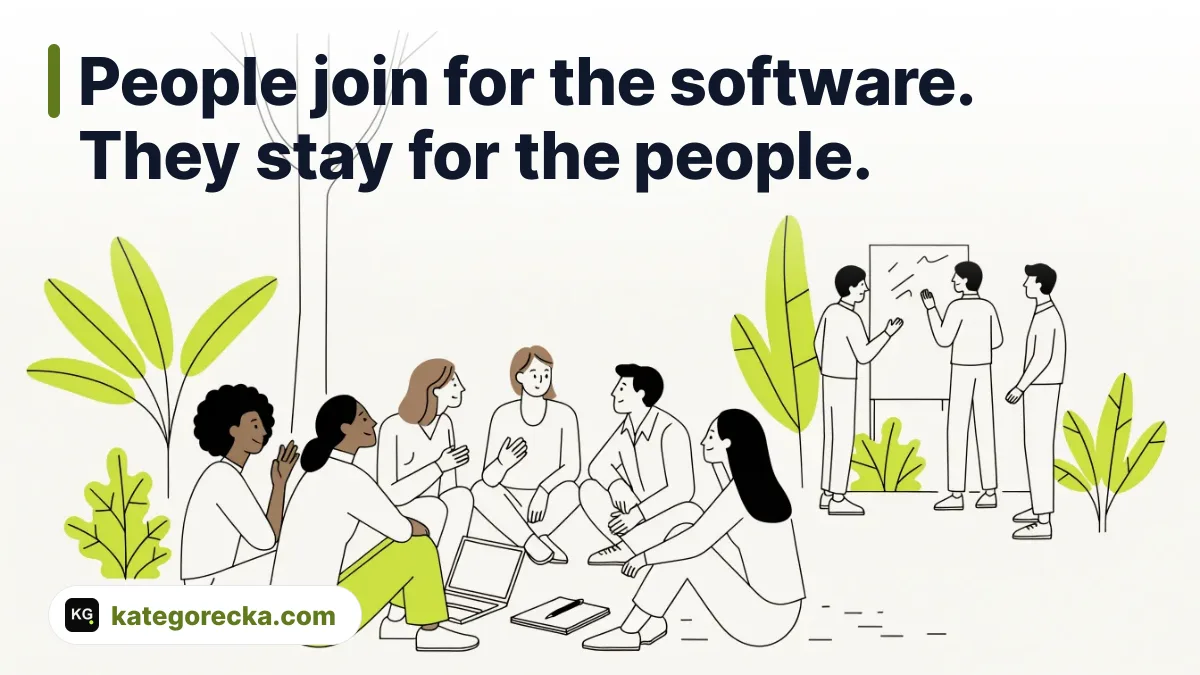
Most founders think their product is the dashboard, the API, the feature list. I see it differently. In B2B, your real product is often the community around the tool, not the tool itself. Community-led growth is a go-to-market strategy that turns engaged users, customers, and partners into the main engine for awareness, adoption, and retention. People join for the software. They stay for the people solving the same problems next to them.
I'll give you a short list of real platforms, the honest trade-offs, the traps nobody warns you about, and a way to decide if this fits your stage.
Table of contents
Why I argue your community is the real product
Features get copied in a quarter. A community that trusts each other does not. That gap is the whole argument.
This strategy leans on something competitors can't screenshot: relationships. When a user answers another user's question at 11pm, your support cost drops and your retention climbs at the same time. That's the network effect - each new member makes the space more useful for everyone already inside. In B2B this matters more than in consumer apps, because buying decisions run on trust and peer proof. A prospect believes another operator in their industry faster than they believe your landing page. Build a community and you've built the one moat a well-funded competitor can't buy overnight.
In B2B, software is the reason people arrive, but community is the reason they refuse to leave.
The shift here is from funnel to flywheel. A funnel ends at the sale. A flywheel keeps spinning: a happy member refers two others, those two generate feedback that improves the product, and the better product attracts more members. Growth that compounds instead of resetting every month.
The platforms I'd actually shortlist in 2026
You don't need to build community software from scratch. Several mature tools handle the infrastructure, so you can focus on the people.
| Platform | Best for | Standout feature | Pricing model |
|---|---|---|---|
| Circle | Course creators, paid memberships | Clean member spaces plus courses | Paid tiers, monthly |
| Bettermode | B2B product communities | Deep customization, SEO-friendly pages | Paid, custom plans |
| Discord | Developer and technical users | Real-time chat, voice, bots | Free with paid boosts |
| Slack | Partner and customer communities | Familiar to business users | Free tier, paid upgrades |
- Circle.so - a hosted platform for paid communities, courses, and events. Good when you want members to pay directly. Downside: it can feel heavy for a tiny early group.
- Bettermode - built for product-led companies that want a branded, searchable hub. Strong for B2B. Downside: more setup work upfront.
- Discord - free, fast, and where technical audiences already live. Downside: chaotic and off-putting to non-developer buyers.
- Slack - lowest friction for B2B partners. Downside: no free message history beyond limits, and search gets painful at scale.
Who it's for: founders who want proof of community engagement before investing in custom infrastructure.
How community-led growth beats product-led growth alone
Product-led growth is about the product driving signups, free trials, and self-serve onboarding. This approach sits on top of that. It adds the human layer PLG forgets: shared identity, peer learning, and a reason to open the app when there's no urgent task.
Take Figma and Notion. Figma users share plugins, files, and resources that quietly pull new people into the ecosystem. Notion users publish templates that act as free marketing for the core product. Neither growth path came from a sales team. It came from members creating value for other members. A community is what turns those template authors and plugin makers into unpaid distribution.
I build my own B2B products, including MYBZZ, around this exact idea - connection first, features second. The automation makes the tool useful. The network makes it sticky.
Want to grow faster?
On MYBZZ you will meet entrepreneurs who think like you. And seoapp.ai makes sure clients find you on Google - on autopilot.
The traps nobody warns you about
This model fails more often than it succeeds, usually for reasons that have nothing to do with the software.
The first trap is launching to an empty room. A community with four posts a week feels dead, and dead spaces repel people. You need a critical mass of early members willing to talk before you open the doors widely. The second trap is treating community as a marketing channel instead of a product. If every post is a promo, members leave. Value has to flow to them, not just from them. The moment members smell a funnel, the trust that made the space valuable evaporates.
Here's the strongest objection to my thesis: "Community is slow and unmeasurable, so it's a vanity project." Fair worry. My answer is that you measure it like any product - active members, reply rates, retention of community members versus non-members. If those curves don't move, fix it or kill it. Unmeasurable is a choice, not a fact.
Who should start, and who should wait
If you have under 50 users and no clear problem, building a community is premature optimization. You'll spend months moderating silence. Focus on validation first.
You're ready when three things are true: users already email you unprompted, you keep answering the same questions twice, and your buyers naturally talk to each other about the problem you solve. That last signal is the big one. Industries where peers compare notes - operators, founders, specialized B2B roles - are perfect for community strategies.
The community manager role matters more than people expect. Someone has to welcome new members, spark conversations, and protect the tone. Without that human, even the best platform goes quiet. I write more about connection-first tooling over on Kategorecka.com, where I break down how automation and networking fit together.
FAQ
What is community-led growth in simple terms?
Community-led growth is a go-to-market strategy where engaged users, customers, and partners drive awareness, adoption, and retention. Members help each other, advocate for the product, and give feedback that improves it. It turns your user base into your primary growth engine.
Is this model only for B2B companies?
No, but it fits B2B especially well because B2B buying runs on trust and peer proof. Consumer brands use it too, through fan communities and user groups. The deciding factor is whether your audience naturally wants to talk to each other about the problem you solve.
How long before results show?
Early momentum depends on hitting critical mass - enough active members that conversations happen without you pushing every one. Rushing the public launch usually backfires.
Can a solo founder run this kind of strategy?
Yes, at a small scale. A solo founder can seed a focused community of early users and handle moderation personally. The limit is time - once membership grows, you'll need a dedicated community manager or automation to keep engagement healthy.
Here's what I'd do: stop asking whether your features are good enough and start asking whether your users would miss each other if the community vanished. Pick one platform from the shortlist, invite ten users who already talk to you, and seed real conversation before you promote anything. Measure replies and retention, not vanity signups. If you want to compare notes on building connection-first B2B products, reach out. Community-led growth is the one advantage no competitor can simply outspend.
About the author
Katarzyna Górecka is an entrepreneur with over a decade of experience building technology companies. Since 2010 she has created and scaled B2B and SaaS products including MYBZZ, SEOAPP.AI, and LUKRENA.COM, staying hands-on from code to go-to-market strategy. Follow her work on YouTube and LinkedIn.
Let's build your growth
MYBZZ connects you with the right people, and seoapp.ai makes clients find you on Google. Two engines - one system.